Key Takeaways
- Colic means long stretches of unexplained crying in an otherwise healthy baby. It describes the crying, not the cause. It’s a label, not a reason.
- Birth is hard physical work for a baby, and tension in a baby's neck and spine is a common, overlooked reason for crying, feeding trouble, and poor sleep.
- Pediatric chiropractic care is remarkably gentle, about the pressure you would use to test a peach for ripeness, and it works alongside your pediatrician, not instead of them.
It's 2am, and your baby is crying again. You've fed them, changed them, rocked them, walked the hallway so many times you could do it in your sleep. (Let's be honest, you are basically doing it in your sleep.) Someone, maybe several someones, has told you, "It's colic. They'll grow out of it."
If that's your house right now, you're not alone. And you have more options than waiting it out.
What Is Colic, Really?
Colic is the word for a pattern, not an answer. The classic definition is crying for three or more hours a day, three or more days a week, for three or more weeks, in an otherwise healthy, fed, growing baby. If you've noticed that the definition tells you what your baby is doing, but nothing about why, or how to fix it, you've spotted the problem.
Colic doesn't have a single confirmed cause. Digestive development, feeding issues, allergies, and plain overstimulation all get discussed, and any of them can be part of the picture. But when we look at colicky babies in our office, we very often find something physical going on, and it's something that can actually be examined and addressed.
Why "They'll Grow Out of It" Isn't the Only Answer
Most colic does ease by three to four months. That part is true. But "they'll grow out of it" is often doctor speak for "we don't know what's causing this, so let's wait and see if it corrects itself." Sometimes it does. In the meantime, nobody in your house is sleeping, feeding is a battle, and you, well, you are starting to run on empty.
Waiting is a valid choice. It just isn't the only one. Babies can't tell us "my neck hurts" or "it's hard to turn my head," so crying is the only way they can tell us something is wrong. When we take the crying seriously and look for a reason, we often find one.
What Might Your Baby Be Trying to Tell You?
Birth is physical work for everyone involved, including your baby, even in the smoothest delivery. Long labors, very fast labors, and assisted deliveries and C-sections ask even more of a baby's head and neck. None of that means something went wrong. It means your newborn has a body that went through a real event, and it deserves the same checkup the rest of their body gets.
Signs worth paying attention to:
- A head preference: they always turn their head one way, or can't comfortably turn it the other way
- Uncomfortable laying on their back, or arching away from you
- Nursing well on one side but fussing or refusing the other
- A tense, stiff little body, clenched fists, or a cry that sounds like pain
- Discomfort with head positioning during diaper changes or tummy time
Any one of these is worth an exam. Indicators like these tell us something is off, and they can be gently examined and addressed.
A Story From Our Office
Not long ago, a mom brought her baby boy in because he couldn't turn his head to the left. He could turn right. He could look almost straight ahead. But he could not turn left at all.
Mom set him in a little Snuggle Me cushion with his head toward me, and I put my hands on his neck. I could feel it immediately. The top bones of his neck were severely out of alignment. I applied a very gentle, sustained pressure, about the pressure you'd use to test a peach for ripeness, and I felt the bones gently shift. (You don't often feel movement directly with a baby; this time I did.)
Then he turned his head left, like it was nothing.
Now here's the part that makes me smile every time. At every visit since, he rides in on his car seat, sees me, and starts turning his head right and left, right and left, like he's showing me it still works. It's the most beautiful little victory lap I've ever seen.
What Does a Pediatric Chiropractic Visit Look Like?
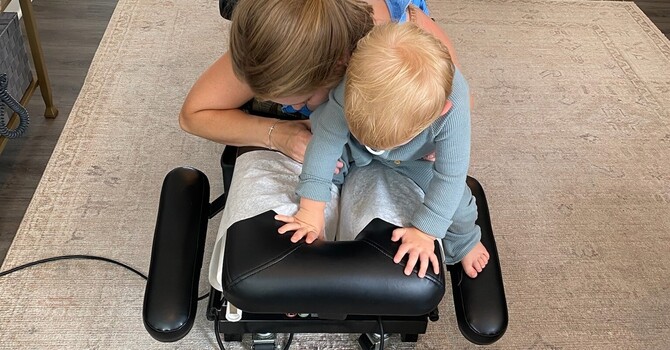
A conversation with you first, then a gentle exam, then, if it's appropriate, an adjustment tailored to your baby. There is no cracking or popping. The pressure used on an infant is about what you'd use to test a peach, a tomato, or an avocado for ripeness, not a squash or a watermelon. Many babies sleep right through it, or right after.
We go at your baby's pace, and we explain everything before we do it. You are welcome to ask every question you have, and we will give you honest answers, including when the answer is "that's not something chiropractic is right for."
Does Chiropractic Care Help With Colic?
One of the best-known studies followed 316 colicky babies treated by chiropractors. 94% of them showed a satisfactory result, most within two weeks, after an average of just three visits. You can read the study here: https://www.dcscience.net/Klougart%20et%20al_1989_JMPT_colic.pdf
Here's our honest framing: chiropractic care is not a cure for colic, and we don't present it as one. What we do is find and gently release the tension that interferes with how a baby's nervous system and body work, so their body can do what it's built to do. Care at Willow complements your pediatrician's care, it doesn't replace it, and we regularly coordinate with and refer to other local providers.
When Should You Bring Your Baby In?
Any time your gut says something is off. You know your baby better than anyone, and a gut feeling is a perfectly good reason to get them checked.
If you're not sure chiropractic is the right next step, start with a free 15-minute consultation. It's a relaxed conversation with Dr. Indy: bring your questions, tell us what's going on, and we'll be straight with you about whether we think we can help. No pressure, no obligation.
We care for babies and families in Doylestown, New Britain, Warrington, Chalfont, Buckingham, Furlong, and across Bucks County.
About the Author
Dr. Indy Ishaya is the owner and chiropractor at Willow Wellness and Chiropractic Care of Doylestown. He holds his Doctor of Chiropractic from Sherman College of Chiropractic and a master's degree in Nutrition and Human Performance from Logan University. He is Webster certified, a certified member of the International Chiropractic Pediatric Association, and co-leader of the Bucks County chapter of the Perinatal Partners Network.